
The Good, The Bad and the Uncertain: Breaking Down Canada’s Mixed Economic Signals
July 29, 2026
The Canadian economy is sending mixed signals. GDP shrank for two consecutive quarters, kicking off a debate about whether Canada is in recession before rebounding in April. Canada shed over 100,000 jobs in the first four months of the year, but back-to-back gains in May and June have since pulled the unemployment rate down to 6.5%. The ongoing conflict in the Middle East has driven up fuel prices, the U.S. administration announced that it would not be renewing the Canada-U.S.-Mexico Agreement (CUSMA), and the President introduced new 50% tariffs on select Canadian goods that would begin in mid-August. Amidst the ongoing uncertainty in the global economy, the Bank of Canada has held its interest rate at 2.25% this year amid sputtering growth and rising inflation.
Beneath these headline numbers are long-term, structural problems: near-zero population growth, declining business investment and a half-century deterioration in Canada's productivity relative to other G7 countries.
As Carol Wilding, FCPA, FCA, ICD.D., President and CEO of CPA Ontario, put it: “If there is one word that captures the mood of Canadians about the state of our economy, it would be unease.”
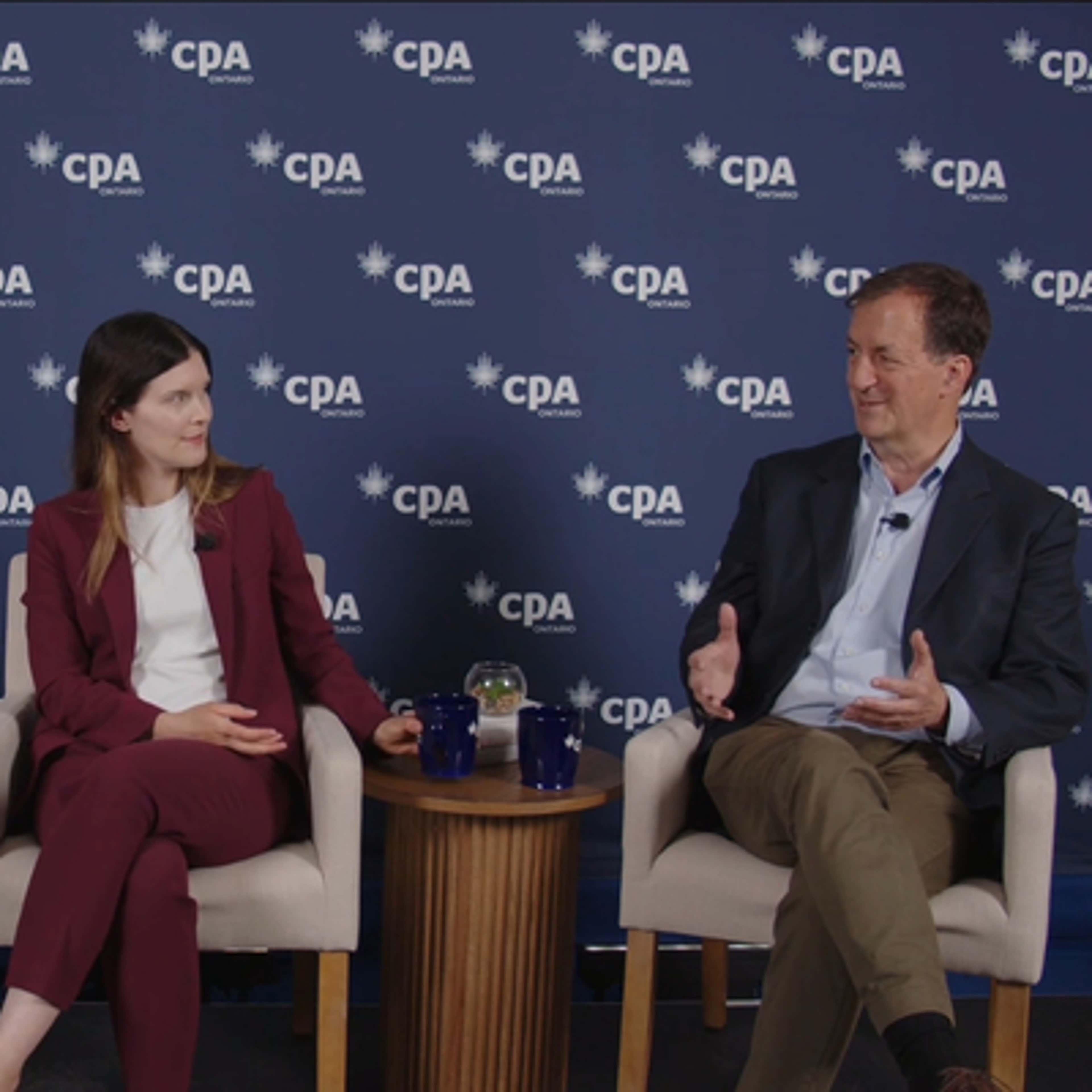
Making sense of those numbers is exactly why CPA Ontario invited two of the country's most astute observers of the Canadian economy — Globe and Mail columnist Andrew Coyne and Cynthia Leach, Assistant Chief Economist, at RBC Economics — to our Insights Speaker Series stage to share their perspectives with CPA Ontario members and students.
The discussion was moderated by Matt Lundy, economics editor at the Globe and Mail. It was held just hours after the Bank of Canada left its benchmark interest rate unchanged at 2.25% (the sixth time in a row it has held) and released its Monetary Policy Report that predicted the Canadian economy would return to growth in the second half of the year and that inflation would ease.
Four Takeaways for CPAs

1. Canada's real economic challenge is long-term, not cyclical
Canadian’s general unease about the economy is showing up in the survey data. "Survey evidence pretty consistently shows that more Canadians think we're in a recession or headed toward one than those who don't believe that," said Leach. But while there is no shortage of evidence pointing to weakness, she argued there are reasons for cautious optimism beneath the headline numbers, pointing to signs that growth will resume in the second half of this year, "on the back of a stronger consumer and more government spending."
For Coyne, however, the debate about whether Canada is technically in a recession was something of a distraction. The bigger question is why growth in the Canadian economy has slowed over the past fifty years. "We're now only able to eke out as a standard rate of growth 1.5% to 1.7% of GDP per year," he said. "We used to grow three times that fast, so we've got a lot of work to do to get our long-term trend growth rate up."
Both panellists agreed that inflation has been lower than feared. Although oil prices have risen since the war with Iran began earlier this year, the impact on inflation and the global economy has been far less severe than previous energy crises. The current interest rate of 2.25% sits in what Leach described as the "neutral zone" — neither stimulating the economy nor putting the brakes on — but she predicted that if growth and employment pick up, an interest rate increase may come in 2027.
2. Trade uncertainty is the new normal
The discussion took place in the week before U.S. President Donald Trump announced he would impose a 50% tariff on a wide range of goods imported from Canada — including hockey sticks, wine and cement — in retaliation for what he called "unequal treatment" of U.S. cars, dairy and alcohol. Trade tensions between the two countries have been building since Trump's second term began in January.
The U.S. remains Canada's biggest trading partner for goods and services, but despite that economic dependency, Coyne argued that Canada must be prepared to negotiate from a position of strength. "We have to be prepared to walk away from the table if we have to," he said. "If you go into any negotiations with the idea that we have to have a deal, you're going to get taken to the cleaners, especially with somebody as aggressive as Trump."
The future of tariff policy remains unpredictable; Leach cautioned that the U.S. could pull out of CUSMA with just six months' notice. Tariff uncertainty, she added, has become the "new normal" for businesses.
3. Focus on what Canada can control
No matter how smart Canada's trade negotiating tactics are, it is nearly impossible to control what trade policies other countries pursue. Both panellists urged the Canadian government and businesses to focus on matters within their control — including boosting productivity and making the country a more attractive place to invest and do business.
"We've got to be focused on policies that will make us competitive as a place to locate and invest in, even in the face of a potential tariff wall in the United States," Coyne said. "We have to sort of Trump-proof the economy."
That resilience can come from several directions. Trade diversification is one — the Canadian government aims to double exports to countries other than the U.S. by 2035. "But in the meantime, it's probably going to take investments in what we’re good at, whether it's energy or critical minerals," Leach said.
Tax reform is another. Coyne argued that Canada's federal tax system has become a tangle of deductions and preferences that distort investment decisions. "It's a mess," he said, urging the government to set up a "wide-ranging" commission on tax reform. Leach agreed, adding that reform could help Canada retain the best workers, encourage more investment and boost innovation.
4. AI will change the nature of work — but not overnight
Both panellists were asked how artificial intelligence is likely to affect the Canadian economy and job market. Leach cautioned that measuring AI's impact is difficult because the technology is not yet in mass adoption. Historically, she noted, there is a lag between a new technology arriving and businesses figuring out how to use it effectively. "In the short term, it could actually be a drag on productivity before having a longer-term boost."
Coyne was more agnostic on the labour market impact of AI noting that previous technologies had changed the nature of work rather than eliminating it — including in accounting. "The spreadsheet was supposed to put all the accountants out of work, and yet there's more accountants employed now than ever," he said. "Why? Because you're using that technology to increase the kinds of products, the kinds of services you can offer to people."
The path forward
The economic challenges facing Canada are significant, from sluggish long-term growth and trade uncertainty to the need for tax reform and the coming impact of AI. But they are also the kinds of challenges that create opportunity for the profession.
Whether it's advising clients on how to scenario-plan for tariff uncertainty, identifying opportunities in new export markets, driving the adoption of AI, or advocating for a simpler and more competitive tax system, CPAs are on the front lines of helping Canada build the resilient, productive economy the country needs. As Coyne put it, governments need to set the framework, "we've got to be focused on policies that will make us competitive as a place to locate and invest in" — and CPAs will be essential to making that happen.